Zinman’s construction skills in Whiteout Survival reduce costs and accelerate upgrades, transforming your frozen city into an unyielding fortress.
In the bygone era of the Sunfire Castle, I first heard the name Zinman whispered among veteran survivors—a legendary architect whose knowledge of construction was said to warp the very fabric of our frozen world. I was a fledgling chief, my city barely a cluster of shivering tents, when I realized that survival in Whiteout Survival wasn't just about brute force. It was about building a fortress that could laugh in the face of endless blizzards.
I remember staring at my upgrade timers, each one a glacier creeping toward completion. Wood and stone costs felt like I was bartering with a miser. Then, as if by fate, the Lucky Wheel spun my way, and there he stood: Zinman, the Greatest Architect. His arrival felt less like recruiting a hero and more like finding the master key to a frozen prison.
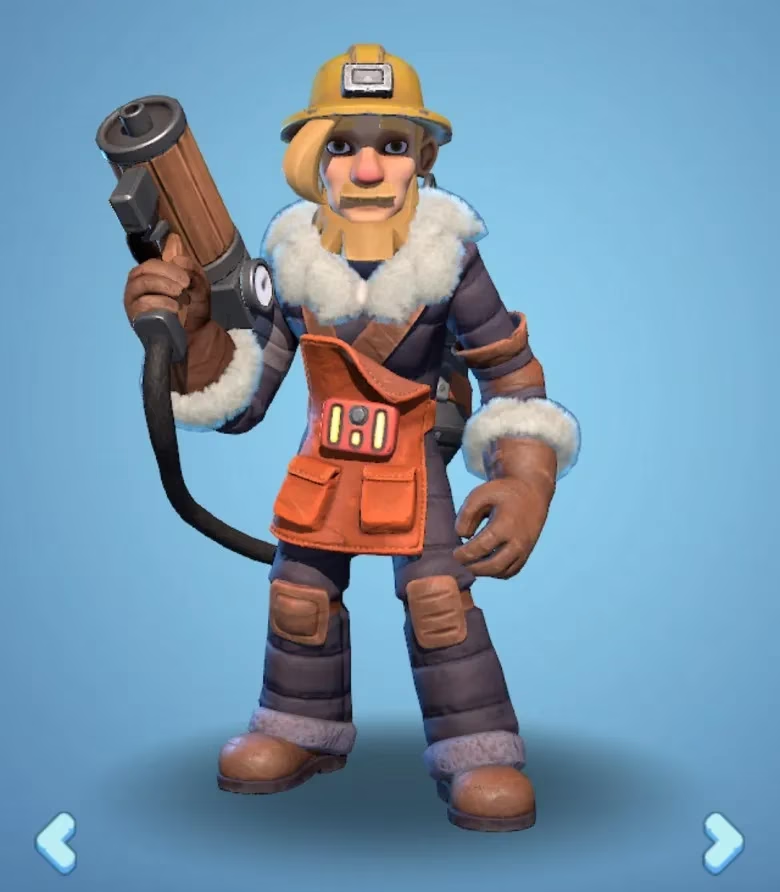
At first glance, my friends scoffed. "He's weak in Expedition," they'd mutter. And on paper, his combat stats don't set the world on fire. But I saw a diamond beneath the rough. His true power lies in his blueprints—specifically his second Expedition Skill, Bastionist . Upgrading this skill felt like discovering a hidden gear in a clockwork beast: suddenly, my city construction costs dropped by up to 15%, and every building upgrade accelerated as if powered by a silent engine. It was the long-term investment that pays dividends every time I log in, a snowball rolling downhill, gathering mass with each passing day.
In those early generations, I also brought Zinman into Exploration and Arena. His Nail Gun skill (Exploration) unleashes a volley dealing Attack * 75% damage and a 2-second stun, which acted like a surgeon's precise staple gun on the battlefield—each nail not just piercing, but stitching my enemies to the ground. When his health dipped below 50%, his Defense skyrocketed by 150%, turning him into a bunker that refused to collapse. With a 30% Attack Speed boost, his toolbelt whirred like a hummingbird's wings, giving me an edge in desperate duels.
But the true renaissance of my city came when I upgraded his Expedition skills. Zinman's logistics expertise sped up building upgrades like a hot knife through frozen butter. Combined with the 15% cost reduction, my resource stockpiles suddenly felt... enough. I could finally afford to dream of a Level 30 Furnace without selling my soul to the trade caravan. His third Expedition skill, Master Strategist, increased all troop damage by 25%, turning my defenders into an army of Frost Giants—not the brute kind, but the precise, calculated kind that wins wars through engineering genius.
As I collected Shards and pushed Zinman to 4 stars (thank you, Lucky Wheel, for being F2P-friendly!), I unlocked his Exclusive Gear—a mythic addition that fit him like a master key in a labyrinth. The Overcharged Nail Gun sent his Attack soaring by up to 24% in Exploration, while in Expedition mode, he constructed an archer tower that boosted Defender Troops' Attack by 15%. This tower didn't just spring from the ground; it bloomed like a metal flower, petals unfolding into a deadly web of crossbow bolts.
I followed a careful upgrade path that felt like composing a symphony. First, I prioritized the Construction Speed skill to lay my foundation, then the Cost Reduction to make every stone count. Combat skills came later, because a strong city is the ultimate weapon. By the time I reached generation 3, my city stood as a monument to Zinman's brilliance—walls that rose in hours instead of days, troops that struck with mathematical precision.
Looking back from 2026, I still see Zinman's influence in every hyper-efficient blueprint I've used. He taught me that the best warrior isn't always the one with the sharpest sword, but the one who built the forge that forged the sword. If you ever spin that wheel and see his weathered face, remember: he's not just a hero. He's a long-term dividend wrapped in a mythic coat, a compass pointing toward a city that can outlast the ice age itself.