Whiteout Survival troop training vs promotion: maximize army strength and resource efficiency for alliance dominance.
In the unforgiving frozen frontier of Whiteout Survival, every decision can mean the difference between a thriving settlement and a frozen graveyard. One of the most persistent dilemmas chiefs face is whether to train fresh recruits or promote the soldiers already shivering in their barracks. At first glance, both options seem viable—one expands the army’s size, the other sharpens its fangs. But what truly separates a struggling outpost from a dominant alliance power? The answer often lies in how well a player reads the current state of their forces, resources, and event calendar.
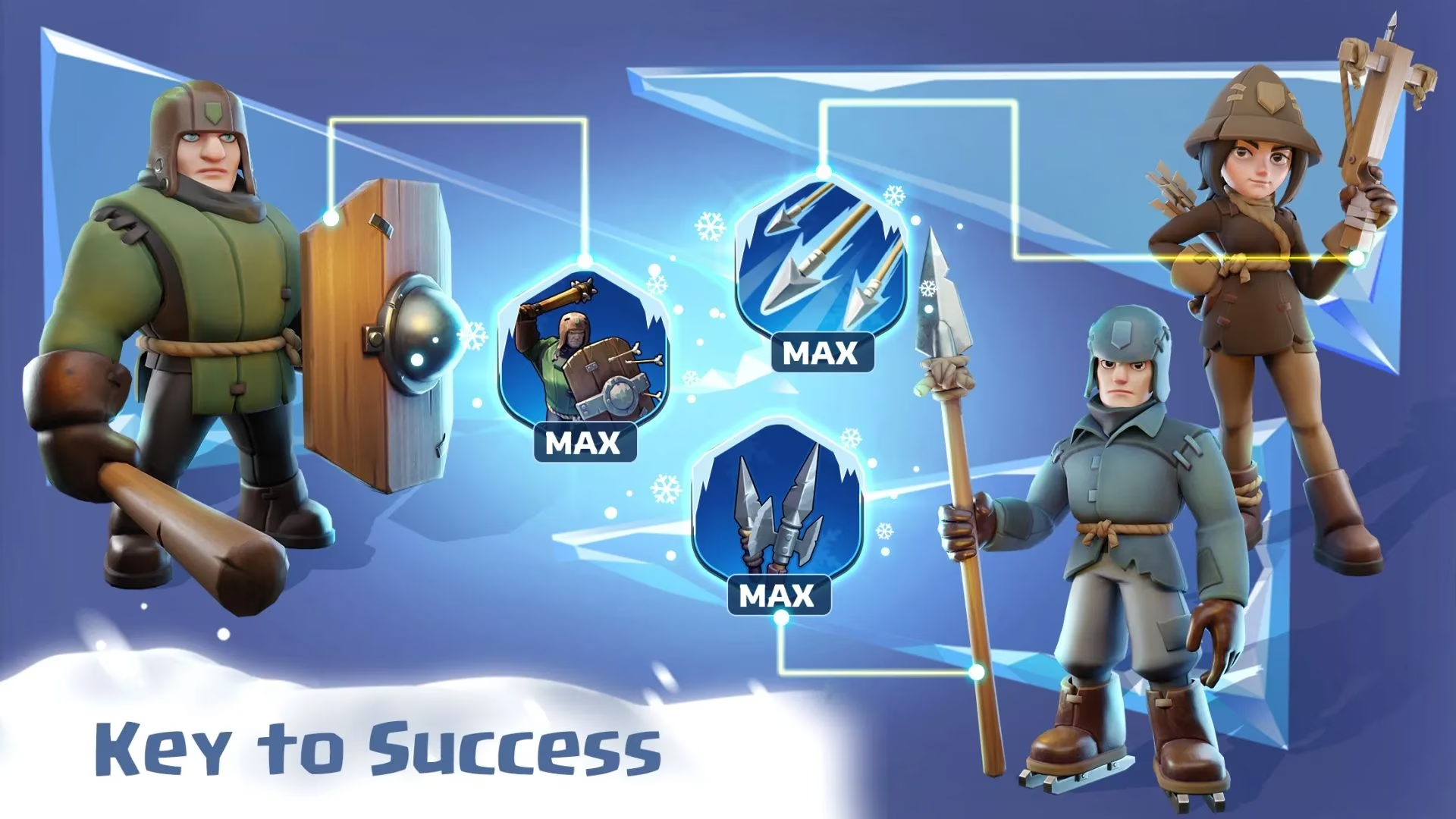
🛡️ When Training New Troops Becomes the Obvious Priority
For many mid-game and early-game commanders, sheer numbers dictate survival. A thinly manned infirmary and empty march queues are invitations for disaster. If a player cannot fill all available march slots, training new units is not just advisable—it is essential. March queues act as the backbone of multi-tasking; without a full complement, participation in simultaneous rallies, resource gathering, and events like Bear Hunt becomes severely hampered. Why would a chief ever skip the chance to earn more rewards simply because their army is too small to show up?
In the earliest stages of development, the math is brutally simple. A fledgling settlement lacks the resource stockpiles and infrastructure bonuses needed to make promotion efficient. Training new troops from scratch consumes fewer rare materials such as Fire Crystals or advanced alloys, allowing a steady stream of soldiers to flood onto the battlefield. This raw headcount pays immediate dividends — intel missions demand bodies, beast hunts require relentless waves, and alliance rallies cannot afford empty slots. A larger pool also means a chief can divide forces between garrison duty, construction escort, and offensive marches without ever being caught off guard.
Numbers also bring a hidden advantage: absorption capacity. Low-tier troops might be individually fragile, but in large quantities they act as a buffer, absorbing the first volleys and protecting high-value units. However, this cushion only works if the infirmary is not overwhelmed. Players who focus on training early often find they can withstand longer sieges simply because their front lines are so deep.
⚔️ The Case for Promoting: Quality Over Quantity
Once a settlement has established a respectable troop count and resources start flowing more consistently, the narrative shifts. High-tier troops are not just a luxury; they are a necessity against the growing threats of the wasteland. Events like Crazy Joe, where waves of infected crash against the walls, demand squads with superior stats to withstand the onslaught without filling the infirmary at an unmanageable pace. Would a leader really stay the course with basic spear wielders when armored cavalry with superior defense and attack can hold the line for half the losses?
Promotion becomes a smart choice when march queues are already full and the chief notices diminishing returns from adding more low-grade units. Elite troops possess better resilience, meaning fewer end up in the healing queue after each battle. This keeps recovery times manageable and ensures that in rapid-fire events — such as Alliance Mobilization or Hall of Chiefs — points are maximized. Many of these special events explicitly reward promotion over training, offering double or even triple event points for every tier upgrade. Ignoring those bonuses is like leaving precious diamonds buried in the snow.
Resource costs, although steeper for promotion, are offset by long-term savings. High-tier units survive encounters that would wipe out their lower counterparts entirely. A dead soldier represents a complete loss of training time and resources, while a promoted veteran simply limps to the infirmary to fight another day. Over weeks of conflict, the efficiency of a promoted army becomes undeniable.
🔄 The Balancing Act: Reading the Situation
The relationship between training and promotion is not a binary choice but a spectrum that shifts with a player’s progress. Consider the following strategic snapshots:
-
Early Game (Furnace level 1–20): Chiefs should almost exclusively pump out fresh troops. The goal is to reach four full march queues, maintain constant activity in alliance rallies, and never miss a Bear Hunt or intel refresh. Resources are too tight to justify lengthy promotion timers.
-
Mid Game (Furnace 21–28): Once tier 7 or 8 troops are unlocked, a staggered approach works best. Train new units only to replace significant losses, while directing all excess speedups and resources toward promoting the remaining lower tiers up to the current maximum. This gradually transforms a bloated militia into a streamlined, lethal force.
-
Late Game (Furnace 29+): With most queues maxed and resource generation robust, the emphasis flips entirely. Promotion becomes the default state, only interrupted if a brand new tier is unlocked and a fresh batch needs to be trained from scratch to replace outdated tiers.
A useful rule of thumb: if the infirmary is constantly at capacity during ordinary PvE missions, the army likely contains too many low-tier troops that are soaking damage inefficiently. That’s a clear signal to promote. Conversely, if march queues remain partially empty and event participation is spotty, training is the missing ingredient.
📌 Quick Decision Table
| Situation | Recommended Action |
|---|---|
| March queues not full | ✅ Train new troops |
| Abundant resources, infirmary overflows with low-tier injured | ✅ Promote troops |
| Alliance Mobilization or Hall of Chiefs event is active | ✅ Promote troops (event bonus) |
| New tier just unlocked, old tier still dominates barracks | ✅ Promote troops gradually |
| Low troop count overall, cannot join multiple rallies | ✅ Train new troops |
| Prepping for Bear Hunt with full queues but weak stats | ✅ Promote to increase damage per march |
🧊 Final Considerations
The ultimate destiny of every unit is to reach maximum level, but that journey is a marathon, not a sprint. Chiefs should periodically audit their troop composition, check upcoming event schedules, and weigh the opportunity cost of each training queue against the immediate needs of their alliance. A patient commander who promotes in harmony with the game’s rhythms will eventually field an army that not only outnumbers rivals but outclasses them in every stat.
No decision in Whiteout Survival exists in a vacuum. Resource availability — especially the scarcest commodities like Fire Crystals — often dictates the tempo. Chiefs who neglect crucial upgrade materials might find themselves stuck with a mountain of weak soldiers and no path to improve them. Keeping a forward-looking perspective, where each promotion builds toward a future of dominance, turns a rag-tag band of survivors into an unstoppable war machine. The blizzard rages on, but with the right balance of fresh recruits and hardened veterans, any chief can carve their legend into the ice.
What other strategies have proven decisive in the frozen wilderness? Every shared insight helps the community stand stronger against the cold.