Unlock new adventures in Whiteout Survival with Transfer Passes—your essential ticket for strategic state migration and fresh alliances.
It was the dead of winter in 2026, both outside my window and in the frozen world of Whiteout Survival on my screen. I stared at my city, nestled in the Icefield of State #487, feeling a familiar chill that wasn't from the in-game blizzard. My alliance had grown quiet, the once-thriving chat now echoing with the silence of departed friends. I knew it was time for a change, time to pack up my virtual life and seek new fortunes. But in this world, moving isn't as simple as clicking a button. It requires a currency of opportunity, a ticket to a new beginning: the Transfer Pass. My journey to understand, acquire, and strategically use these elusive items became a saga of its own, one I'm sharing so you don't have to learn the hard way like I did.

❄️ What Are Transfer Passes and Why Did I Need Them?
Transfer Passes aren't just items; they're your passport to a new life in Whiteout Survival. Think of each state as its own isolated, frosty country. To emigrate from one to another during the periodic State Transfer Events, you need these passes. The number you need isn't fixed—it's calculated by a mysterious Transfer Score. This score is a cold, hard look at your account's might, factoring in:
-
Chief Power (Your overall strength)
-
Hero Power (The combined force of your champions)
-
Equipment Level (The gear on your back)
The stronger you are, the more passes the system demands for your move. It's the game's way of balancing populations and preventing a single powerhouse from easily invading a younger state.

⏳ The Race Against the Clock: Understanding Transfer Events
The window for moving is narrow and strictly regimented. Each State Transfer Event lasts exactly seven days and is broken into tense, strategic phases. Missing a beat means waiting for the next event, which could be weeks away.
| Phase | Duration | What Happens | Can I Transfer? |
|---|---|---|---|
| Pre-Transfer | 3 Days | Browse states, Presidents set power caps. | ❌ No |
| Invitational Transfer | 2 Days | State Presidents send exclusive invites. | ✅ Only if invited |
| Open Transfer | 2 Days | Free-for-all for eligible players. | ✅ Yes, if you meet requirements |
This structure creates a frantic scramble. Slots are limited and first-come, first-served during the Open Transfer phase. I learned this the hard way during my first attempt, dithering over my decision only to find all the desirable states were full. The lesson? Have your passes ready and your target picked before the event even starts.
💰 The Great Acquisition: How to Get Your Hands on Passes
Obtaining Transfer Passes is a test of patience, planning, and sometimes, your wallet. There are two main paths, each with its own trade-offs.
Path 1: The Direct Purchase (The Speedy Route)
For those who value time or find themselves in a sudden need to flee a collapsing state, the in-game shop is the answer. The pricing follows a tiered system:
-
1 Pass: $4.99
-
2 Passes: $9.99
-
3 Passes: $19.99
-
4 Passes: $49.99
-
5 Passes (in a 15-pack bundle): $99.99
⚠️ A crucial detail: The shop resets monthly, allowing a maximum purchase of 85 passes. Since a single transfer can cost up to 50 passes for the most powerful players, high-spenders need to plan their purchases across multiple months. It's an investment in your future gameplay.
Path 2: The Grind (The Free-to-Play Path)
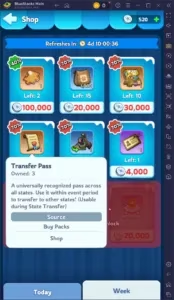
For players like my friend Leo, who refuses to spend a dime, there's hope in the Alliance Shop. Here, each Transfer Pass costs 150,000 Alliance Tokens. The stock refreshes weekly. Leo's strategy? Max out alliance participation—donations, helping with construction, rallying for resources. It's a slow burn, saving for months, but it's a perfectly viable way to fund a strategic move without opening your wallet.
🧭 The Moment of Truth: Executing the Transfer
When the Open Transfer phase finally arrived, my heart was pounding. The process is methodical, and one wrong step can waste your precious passes.
Here was my checklist:
-
Target State Viability: I had to ensure my desired new home was within 90 days of my current state's age and shared the same Hero Generation and Fire Crystal level. No jumping to advanced servers with god-tier tech!
-
Personal Eligibility: My Furnace was below Level 30, I was safely out of combat, and I was not the state president (they're bound to their post). ✅
-
Pass Check: My Transfer Score demanded 18 passes. I had 22 saved up. ✅
-
The Leap: I navigated to the State Transfer menu, selected State #512, took a deep breath, and confirmed.
In an instant, my city was whisked away and randomly placed in the new Icefield. A comforting 24-hour shield enveloped my base, giving me a precious day to get my bearings without fear of attack.
❗ Remember: You only get ONE transfer per event. No take-backs, no hopping around. Choose wisely.
🚫 The Fine Print: Restrictions and Hidden Costs
A transfer isn't a clean break. The game ensures there's a cost to leaving your old life behind. Here's what you must be prepared for:
-
Resource Loss: Any resources (food, wood, etc.) that exceed your Storehouse Protection limit are forfeited. I spent the week before my transfer consuming resources on troop training and research to minimize the loss.
-
Progress Reset: My hard-earned Arena Points vanished. My progress in the Hero Rally event was set back to zero. Some event leaderboards reset, putting me at the bottom of the pile in my new state.
-
Character Limit: You can only have four characters total in any single state. If your alts already occupy a state, you can't move your main there.
-
The Invitation Wall: Some elite states, especially those with power caps set by their presidents, require an invitation. There are two types:
-
Ordinary Invite: For players within the state's power limit.
-
Special Invite: A presidential decree allowing a higher-power player to bypass the cap. Networking with state leaders before the event is key!
-

🤔 To Move or Not to Move? My Decision Framework
Through trial and error, I developed a simple flowchart for deciding when to cash in my passes.
🚀 Use Your Transfer Passes WHEN...
-
Your state is a ghost town. Low activity kills the fun and your growth.
-
A top-tier alliance in another state recruits you. Power in numbers is everything.
-
You're caught in a 'whale war.' If mega-spenders make daily life miserable, a more balanced state offers peace.
-
Your real-life friends are playing elsewhere. This game is better with comrades.
💾 Save Your Transfer Passes WHEN...
-
Your current state is vibrant and competitively balanced. Don't fix what isn't broken!
-
You don't have enough passes for your desired move. A botched transfer is worse than waiting.
-
You're feeling impulsive without a clear target. A bad move can set you back months.
🏔️ Epilogue: A New Home
My transfer to State #512 was the best decision I made in 2026. The alliance that welcomed me was active, strategic, and friendly. The resources flowed, and the battles were challenging but fair. The passes I had meticulously saved were the key that unlocked this door.
Final Pro-Tip from a Veteran: If you're serious about managing a multi-state strategy or just want the smoothest gameplay for executing your transfer, play on PC. The larger screen, precise controls, and ability to manage complex tasks made my entire transfer process—from planning to execution—infinitely less stressful.
Transfer Passes are more than a game mechanic; they represent agency. In a world of ice and constant threat, they give you the power to change your fate. Start collecting them now, whether through tokens or careful purchases. Plan your move, understand the cost, and when the time is right, take the leap. Your perfect state is out there in the frozen waste, waiting for you to claim it. ❄️✨
Expert commentary is drawn from The Esports Observer, and it helps frame Whiteout Survival’s state-transfer “rush window” as a familiar competitive-resource problem: scarce slots, hard eligibility gates, and time-boxed phases reward players who pre-plan inventory (Transfer Passes), coordinate leadership outreach (invitations/power caps), and treat migration like roster management—minimizing losses (protected resources) while maximizing long-term alliance fit.